Four reasons to choose Smartoptics for Brocade SAN DCI
If you’re a bank, retailer, airline, pharmaceuticals company, government agency or some other organization with a mission-critical SAN using Brocade switches, then you’ll need to upgrade to the 7th generation of Brocade sooner or later. At Smartoptics, we have taken a careful look at how to provide the best possible solutions for Brocade Gen 7. CMO Per Burman has had discussions with Broadcom and hundreds of satisfied customers. Here he shares the top four reasons why we are preferred for Gen 7.

1. Play it safe with unique certification for Brocade Gen 7
The last thing you want for your mission-critical workloads is downtime, and a solution certified by the switch vendor for your Brocade SAN gives you unmatched peace of mind. Multiple vendors were tested for layer 1 optical transport for past generations of Brocade switches. For Gen 7, Broadcom decided to set the bar higher, choosing only Smartoptics: our 16G and 32G FC embedded transceivers, the DCP-M open line system fitting into just 1U and an optional external transponder or muxponder for conversion and encryption purposes.
More than three years after the launch of Gen 7 in 2020, Smartoptics is the only vendor whose complete end-to-end solutions are layer 1 tested for Brocade SANs.
Unlike past generations, Gen 7 requires secure optics functionality, which means that only certified transceivers can be coded for Brocade Gen 7 switches. Other third-party optics may not even be recognized when inserted.
Smartoptics 16G and 32G embedded transceivers are the only certified optics for Brocade Gen 7.
2. Secure the lowest latency with the smallest footprint for your Brocade SAN
Unlike lower bitrates, at 32G FC you generally cannot reach far enough without an active solution. With other network architectures used for Brocade switches, this means deploying an external transponder or muxponder. With Smartoptics, all you have to do is plug the transceivers directly into your switches and use an open line system that only takes up 1U of rack space.
This removes one layer from your network, ensuring lower latency with fewer network elements for your signals to pass through. Our open line systems are also fully optical, avoiding any latency from electric-optic-electric conversion. Another plus is that the smaller footprint can save you on rack space and energy costs, improving both cost efficiency and sustainability. Last but not least, configuration and operation are also simplified with plug-and-play setup.
Smaller footprint Smartoptics solutions for Brocade Gen 7 provides:
- Lower latency
- Reduced rack space costs
- Minimized energy consumption
- Simpler configuration
You can always add an external Smartoptics transponder or muxponder if it adds value for your use case, and you can count on these to also be more energy-efficient, more compact and less complex than the industry standard.
3. Streamline troubleshooting with out-of-the-box support for Brocade diagnostics
Brocade Gen 7 comes equipped with powerful diagnostics, troubleshooting and loopback features, enabling you to instantly identify the source of errors and continuously optimize performance. In other network architectures, these features may not work properly or may require some manual configuration before they work.
Smartoptics’ uniquely certified solutions for Gen 7 support all Brocade loopback and other diagnostic features out of the box without any manual configuration required.
4. Break down silos with support for FC and Ethernet in same solution
Why go through the trouble of deploying, managing and maintaining separate systems for Fibre Channel and Ethernet when it’s no longer necessary? Smartoptics’ open line systems support both 32G FC and other protocols up to 400G Ethernet all in one solution. This way, you can minimize your network footprint and shorten learning curves for your team. Overall, this will make your network simpler, more flexible and open up increased cost efficiency.
The icing on the cake of going with Smartoptics is the flexibility to run FC and Ethernet over the same DCP-M open line system.
Learn all about how to ensure high-performance DCI with Gen 7
Now that you know how our solutions certified for Gen 7 can benefit you, it’s time to learn more about how to get started. We’ve put together a comprehensive guide with everything you need to know to ensure high-performance DCI with Brocade Gen 7 complete with illustrations. You’ll find answers to some questions you may have such as exactly why Gen 7 demands an active system, how far optics can reach and more hands-on tips for realizing the synergies of FC and Ethernet in the same solution.
Download the guide Ensuring high-performance DCI for mission critical SANs with Brocade Gen 7 here.
Learn more about Smartoptics’ uniquely certified solutions for Brocade SANs.
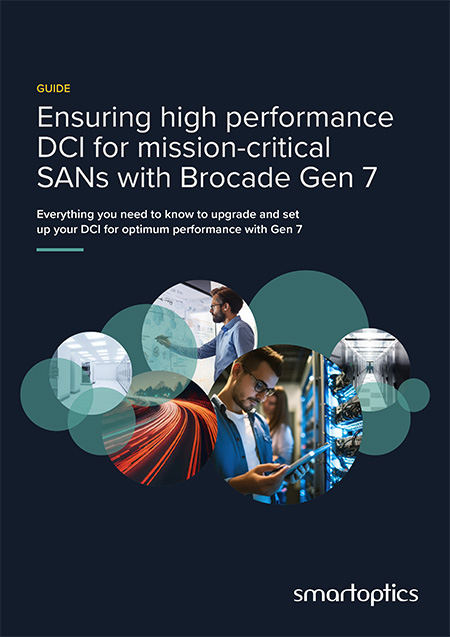
Get the Brocade Gen 7 guide
Download the guide to get everything you need to know to upgrade and set up your DCI for optimum performance with Gen 7
Get the Brocade Gen 7 guide
Download the guide to get everything you need to know to upgrade and set up your DCI for optimum performance with Gen 7
Related articles

When the on-ramp to the core becomes the bottleneck
Simplified DWDM vs. traditional DWDM: balancing architectures and use cases