How SoSmart enables enterprise DCI management with DCP-M
Open line systems such as our DCP-M give enterprises a compact, open optical foundation for data center interconnect, with scalable wavelength and bandwidth capacity and without hidden license fees. To ensure reliable operation, enterprises must also secure stable data replication between data centers, detect gradual fiber degradation and maintain traceable control over configuration changes across sites.
The SoSmart software suite complements DCP-M with a range of advanced capabilities for robust monitoring and operational control in open, multi-layer environments. It brings visibility to the physical layer, correlates optical conditions with the services they support and embeds governance controls into daily workflows. Learn how the combination of SoSmart and DCP-M supports your DCI operations with reliable performance, service integrity and compliance.
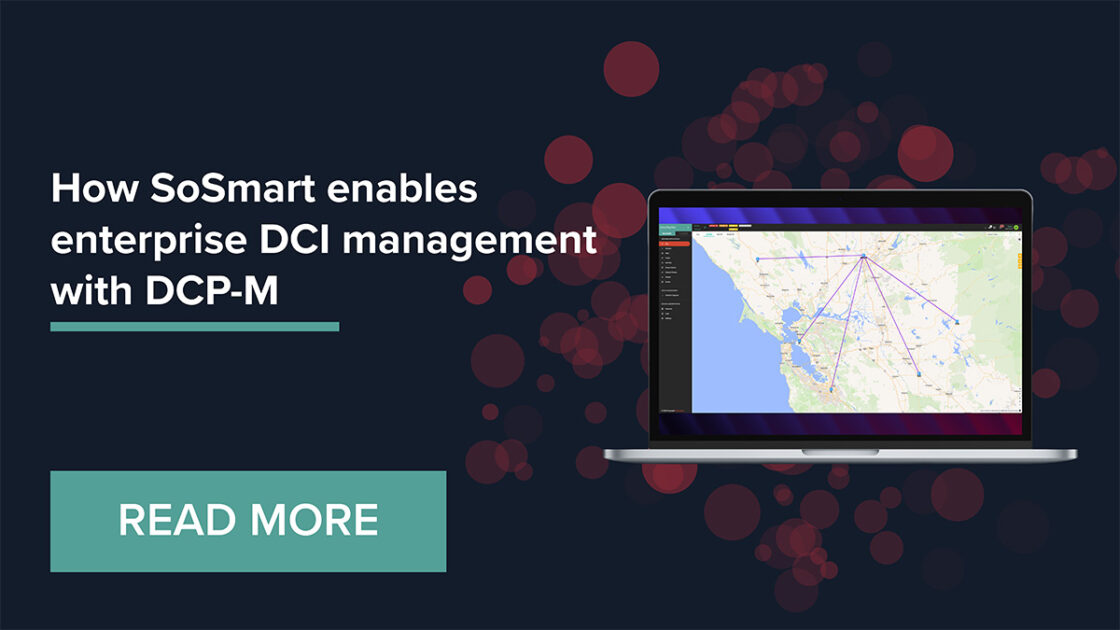
Detecting gradual degradation before it impacts services
In enterprise data center interconnect environments, disruption often begins quietly. Although services remain up, performance begins to drift. Small changes in attenuation or signal quality can affect replication and application responsiveness without triggering a clear fault.
Without structured optical visibility
- Replication between data centers begins to fluctuate
- Applications report intermittent latency spikes
- No hard fault is raised and the link remains operational
- Troubleshooting focuses on IP and storage layers while the physical layer remains out of view
With SoSmart for DCP-M
- Span loss baselines are stored at commissioning
- Live fiber span attenuation is compared continuously against reference values
- Threshold-based alerts highlight deviations early, based on user-defined baselines and severity levels
- Engineers see exactly which span is changing, with clear location and interface context for faster troubleshooting
By reading fiber characteristics directly from DCP-M devices and maintaining measurable baselines, SoSmart makes gradual degradation visible before it escalates into service impact.
Early visibility into fiber degradation protects replication stability and prevents avoidable service disruption.
Improving service-level visibility across the full path
When a service between data centers shows instability, you need to understand whether the issue originates in the fiber, the optics or the workload itself. Isolated interface statistics rarely provide the full picture in hybrid environments that may include IP-based traffic alongside Fibre Channel SAN workloads. What matters is visibility into the complete service path between sites.
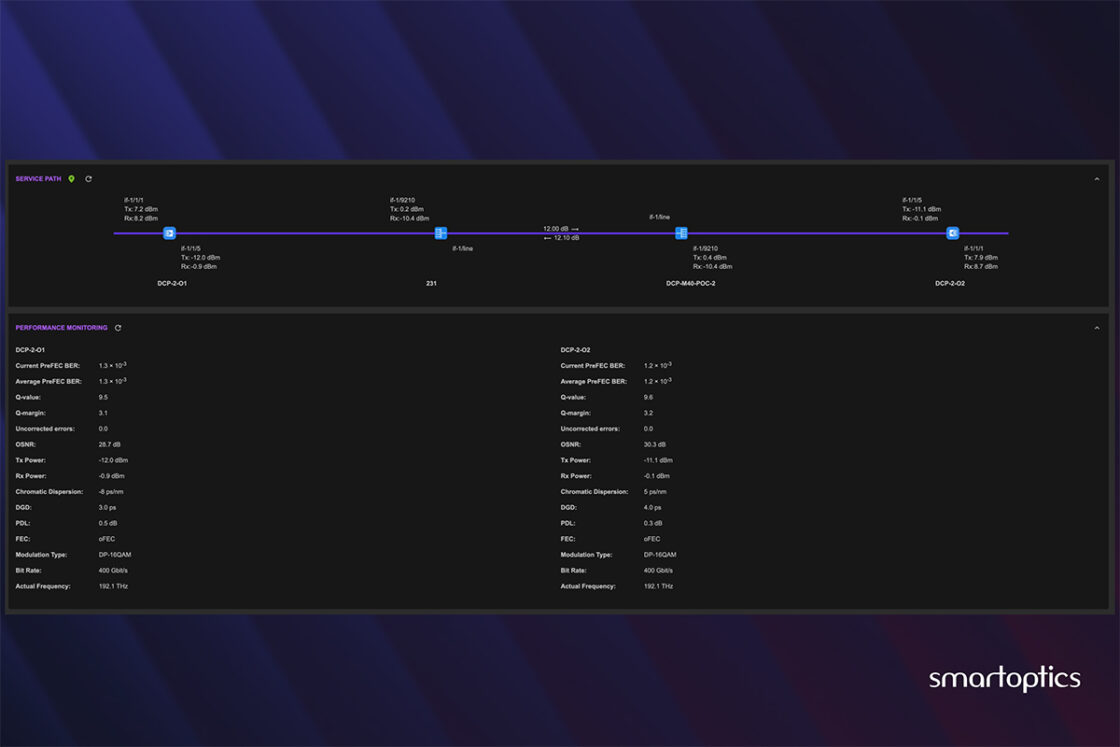
The service path view shows the complete optical path between supported network elements, in this case two DCP-M endpoints and a DCP-404 Muxponder. The view provides span-level attenuation and key optical parameters such as Tx and Rx power levels across interfaces, along with critical transmission metrics such as OSNR and pre-FEC BER for coherent transceivers.
These values are continuously monitored and stored over time, allowing engineers to track performance trends and detect emerging stability or degradation issues. When a configuration adjustment introduces unexpected attenuation on one segment, the selected service can be traced across each span, with loss values compared against commissioning baselines to quickly identify where conditions have shifted.
See how TKRZ uses DCP-M and SoSmart to gain full-path visibility and validate network performance across its regional infrastructure:
SoSmart presents the complete service path with correlated performance data across all spans and endpoints.
Root causes are identified faster, reducing troubleshooting time and limiting impact on critical workloads.
Demonstrating route resilience and compliance readiness
In regulated industries and mission-critical environments, uptime alone is not sufficient. The optical layer must meet the same governance expectations as the rest of the data center. This requires you to demonstrate route diversity, control access to critical infrastructure and maintain traceability of configuration changes.
During a compliance review, you are asked to confirm that primary and disaster recovery data centers use physically diverse fiber paths. Network diagrams exist, but incremental changes over time make static documentation difficult to rely on. How do you verify that no shared span compromises resilience? In practice, teams often end up reconstructing service paths manually, cross-checking diagrams against device data to demonstrate route separation.
With SoSmart, fiber paths are visualized using geographic overlays, and services can be traced end-to-end across spans. Configuration changes and user actions are logged centrally, so route diversity and change history are directly observable rather than inferred.
Route diversity and configuration history are demonstrable on demand, simplifying audits and strengthening governance confidence.
Maintaining operational consistency across DCP-M sites
As your data center interconnect environment grows, keeping topology, inventory and software versions aligned across sites becomes harder to manage manually. The challenge is to maintain consistency across sites without introducing additional operational overhead.
During planned expansion or maintenance, configuration drift can quietly accumulate. Differences in software versions, incomplete documentation or missed backups increase the risk of inconsistent behavior between sites.
SoSmart addresses this by supporting topology and service discovery, bulk software upgrades on one, many or all DCP-M nodes at once, and centralized system and network backups across nodes. Role-based access controls help maintain lifecycle consistency and controlled change, with defined user roles and a centralized log of configuration changes and user activity.
- Topology and service discovery provide visibility into network inventory
- Scheduled backups protect system and network state
- Bulk software upgrades reduce manual effort and version variance
- Role-based access and event logging support controlled change
Together, these capabilities keep topology, software versions and configuration state aligned across sites.
Expansion and maintenance can be executed with predictable outcomes and controlled change.
Discover SoSmart for DCP-M
Together, DCP-M and SoSmart give you open optical infrastructure without operational blind spots. You gain scalable wavelength capacity without hidden license constraints, and full service-level visibility without manual reconstruction.
For enterprise DCI environments where stability, governance and flexibility must coexist, SoSmart for DCP-M aligns the optical layer with the operational model of the modern data center.

Get the SoSmart solution brief
Download our solution brief and learn more about DCP Management with the SoSmart Software Suite.
Related articles

When the on-ramp to the core becomes the bottleneck
Simplified DWDM vs. traditional DWDM: balancing architectures and use cases