Enabling end-to-end network management – the pivotal shift in SoSmart
Open line systems such as our DCP-M give enterprises a compact, open optical foundation for data center interconnect, with scalable wavelength and bandwidth capacity and without hidden license fees. To ensure reliable operation, enterprises must also secure stable data replication between data centers, detect gradual fiber degradation and maintain traceable control over configuration changes across sites.
The SoSmart software suite complements DCP-M with a range of advanced capabilities for robust monitoring and operational control in open, multi-layer environments. It brings visibility to the physical layer, correlates optical conditions with the services they support and embeds governance controls into daily workflows. Learn how the combination of SoSmart and DCP-M supports your DCI operations with reliable performance, service integrity and compliance.

From fixed grid to flexible spectrum planning
With a major release in late 2024, SoSmart introduced flexgrid support, enhanced capacity planning, and support for planning 800G services. This allows network operators to define channel widths based on actual service requirements rather than reserving fixed 100 GHz slots across the fiber. Capacity planning makes it possible to allocate individual channels between specific network points and adjust how many channels are used along a route. Directionless capability further removes constraints on how services are assigned across ROADMs, enabling more flexible use of network paths as demand shifts.
“Flexgrid support and 800G service planning serve as important milestones for SoSmart to offer network planners more flexibility. This way, they can work with the spectrum in a manner that reflects real service requirements instead of fixed channel assumptions. Bringing that level of flexibility into a stable management environment was a defining step in the platform’s maturity,” says Alley Hameedi, PLM Optical Solutions, Smartoptics.
In SoSmart, flexible spectrum planning improves fiber utilization and gives network planners more precise control over high-capacity services.
Responding to real-world deployment challenges
In spring 2025, SoSmart expanded in reach, provisioning, and user-friendliness. Support for VG and Raman amplifiers makes it possible to model and manage longer spans directly in SoSmart, addressing customer demand for broader regional network planning. Flexible alarm filtering streamlines operations by allowing users to create and share custom filters, ensuring that each team member sees only what is relevant during maintenance or troubleshooting.
Pre-provisioning addresses a common deployment pain, especially in networks with long distances between sites where coordination between installation and configuration is difficult.
Before pre-provisioning
- Hardware is installed across multiple sites, some far apart.
- Technicians leave, and services are configured later from the office.
- A misconnected port or incorrect parameter is discovered.
- Another visit must be scheduled, adding cost and delaying activation.
With pre-provisioning in SoSmart
- The full service path is defined and reserved in advance, including channel and frequency.
- Installation and configuration are coordinated while technicians are still on site.
- The engineer activates the service in SoSmart and verifies status immediately.
- Confirmation is given on the spot, and the technician can move on.
SoSmart’s pre-provisioning,structured workflows, and scheduled operational events reduce coordination delays and improve efficiency in geographically distributed, multi-team environments.
From layer-specific monitoring to end-to-end visibility
In summer 2025, SoSmart expanded its monitoring capabilities with router port power visibility via NETCONF, fiber fault root cause analysis using OTDR, SNMP-based performance monitoring, and secure SNMPv3 trap support. These additions make it possible to retrieve power and inventory information directly from third-party routers and associate it with optical services across multiple spans and ROADMs. This provides visibility into power levels at active interfaces, helping identify any stability issues earlier.
“We have demonstrated end-to-end visibility, from a router through the optical network and back to another router,” says Alley. “Achieving this level of visibility was initially made possible with routers that fully support the OpenConfig data model. Most commercial routers support OpenConfig only partially or with vendor-specific implementations, which requires careful integration. Proving that this approach works with fully compliant OpenConfig implementations has marked an important step in the evolution of SoSmart. This lays the foundation for work to extend support to more widely used router models.”
With these monitoring capabilities, SoSmart reduces blind spots between IP and optical layers and improves troubleshooting accuracy across the full service path.
Making the network path visible
In January 2026, SoSmart introduced Fiber Route Analysis and enhanced capacity planning, giving network operators clearer insight into how services move through the physical network. Span-level loss visibility and improved graphical route views bring planning and monitoring closer to the actual fiber path.
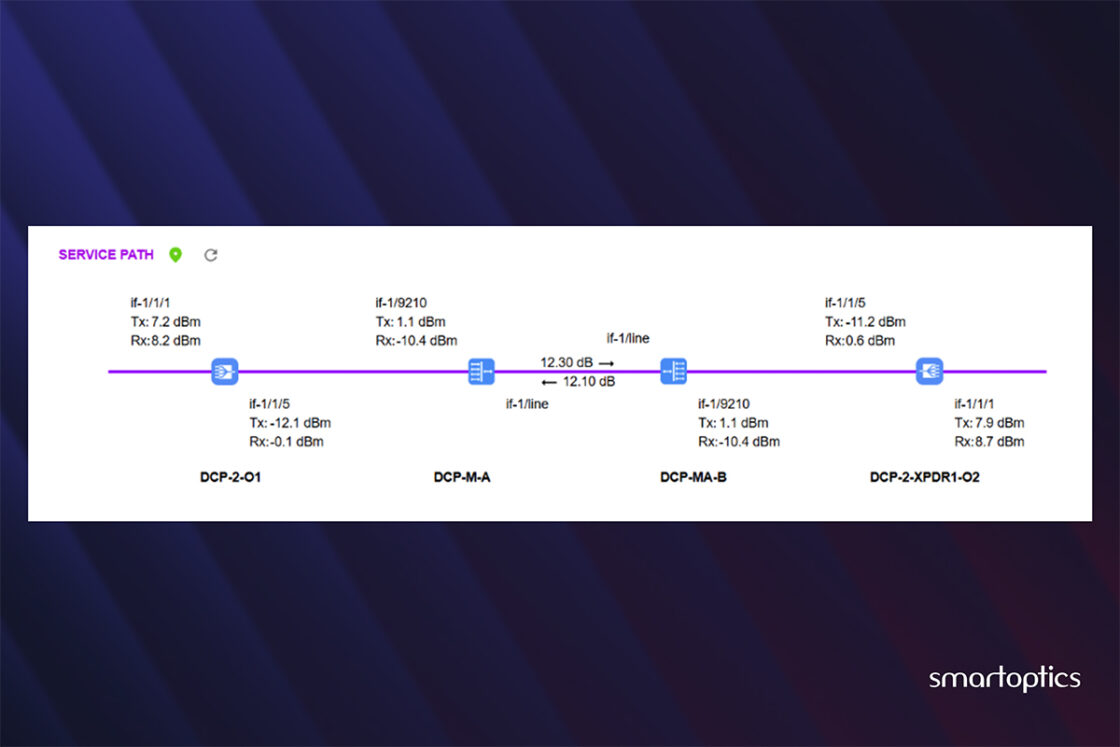
The view above shows a selected service traced across multiple spans, with each fiber segment and its associated loss values displayed along the route. By aligning topology, spectrum allocation, and performance data in a single view, SoSmart makes it easier to validate design assumptions and pinpoint where changes occur along the path.
See how TKRZ used SoSmart to simulate real fiber conditions
and validate its network design with full path visibility.
“In 2025, we saw a clear shift,” says Smartoptics CMO Per Burman. “Customers no longer view SoSmart as an add-on. Our hardware has always been competitive, but the software is increasingly a decisive part of the selection criteria.
The reason is that SoSmart now enables network managers and planners to plan capacity more precisely, activate services faster, and troubleshoot across layers with full path visibility.”
What comes next for SoSmart
Building on these developments, the next phase of SoSmart will continue to expand end-to-end visibility across the full service path, with deeper integration of router layers and broader support for different router models. This will create a more unified view of how services behave across optical and IP domains, bringing network state and service performance closer together.
Tighter integration between planning, provisioning, and monitoring across the network, along with increased automation in how services are managed and adapted, will support this direction. As a result, manual steps will be further reduced, and the time from detection to action shortened across multi-vendor environments.
See what SoSmart can do
Visit the SoSmart product hub for video walkthroughs, an in-depth solution brief, and detailed information about the three core modules. You’ll see how planning, provisioning, monitoring, and route analysis work together in practice.

Get the SoSmart solution brief
Download our solution brief and learn more about DCP Management with the SoSmart Software Suite.
Related articles

When the on-ramp to the core becomes the bottleneck
Simplified DWDM vs. traditional DWDM: balancing architectures and use cases