Three rare value-adding features in QSFP-DD transceivers
Looking for the right coherent QSFP-DD transceiver? While some transceivers share common features across vendors, our high-end coherent QSFP-DD optics stand out with key advantages that enhance performance, simplify encryption and streamline brownfield deployments
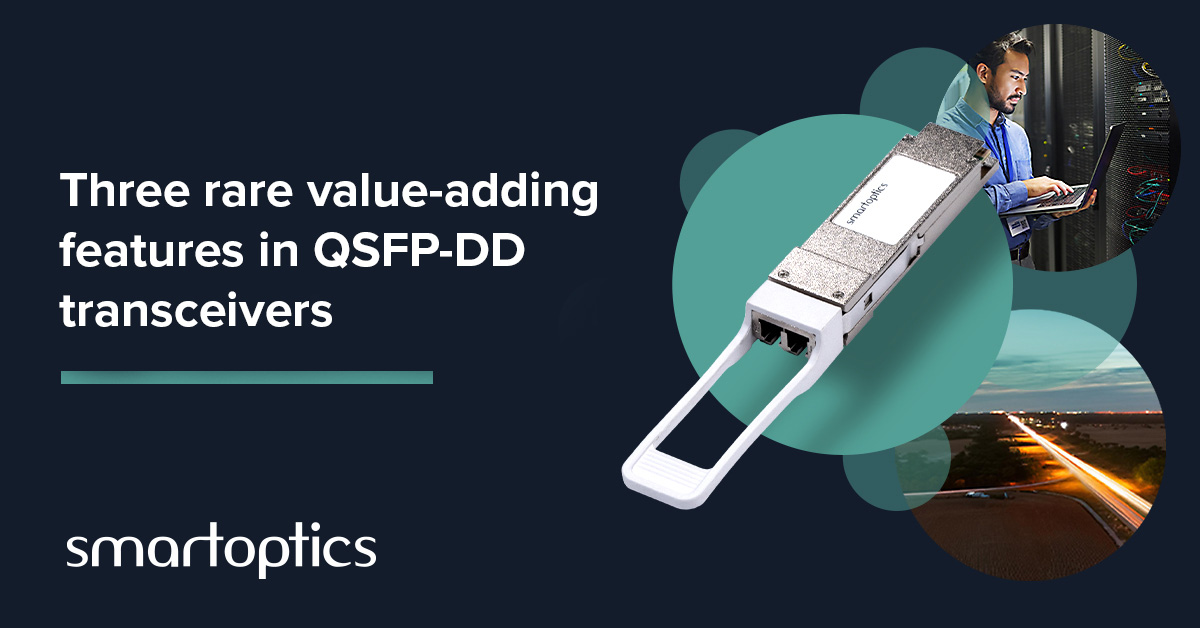
1. Expand network flexibility with OTN-capable QSFP-DD optics
Transceivers that are compliant with the Optical Transport Network (OTN) protocol feature several performance enhancements. Our OTN-capable 100G-400G QSFP-DD optics offer improvements in:
- Efficiency with better bandwidth utilization
- Reach with enhanced performance over long distances
- Flexibility with support for transporting multiple types of signals
OTN-capable QSFP-DD optics are also compliant with the Open ROADM standard, enabling seamless interoperability in ROADM-based networks. This ensures compatibility with standardized optical transport interfaces, including OTN transponders, line systems, and SDN controllers, allowing for flexible wavelength routing and automated provisioning. By adhering to Open ROADM standards, these transceivers support disaggregated network architectures, extending the life of existing ROADMs while simplifying management and orchestration.
Ideal for high-performance applications and ROADM-based networks
2. Secure 400G Ethernet with streamlined layer 1 encryption
As security threats are on the rise and encryption regulations are becoming stricter globally, encryption will be a higher priority for 400G Ethernet networks. Our optics can help you secure your DWDM links easily and increase cost efficiency.
Encrypted 400G services are supported with AES-256 encryption in our QSFP-DD transceivers. The benefit of this layer 1 encryption capability is that it’s more cost-efficient than traditional layer 2 encryption, simplifies deployment and is easy to manage with minimal operational overhead.
Make 400G ethernet encryption more cost-efficient and easier to deploy
3. Upgrade brownfield 50GHz networks without a full overhaul
Brownfield networks still utilizing 50GHz filter spacing are generally limited to max 100G, requiring a network overhaul to support higher bitrates. The typical modulation format used for 100G in legacy DWDM networks is DP-QPSK, fitting well in 50GHz spacing.
Our coherent QSFP-DD transceivers have the capability to run 200G at the DP-16QAM modulation format. With 16QAM, you get double the bits per symbol, which makes it possible to double capacity without having to change spacing. This can add great value for brownfield DWDM networks, avoiding the need to upgrade the entire network architecture.
Upgrade DWDM capacity without having to replace brownfield 50GHz network
Explore our QSFP-DD transceiver collection
These three key features are compelling but not the only reason to consider our coherent QSFP-DD transceivers. At Smartoptics, we deliver more than just high-performance optics – we provide unmatched expertise, rigorous quality assurance and tailored solutions to meet your specific needs. Our transceivers undergo extensive testing to ensure flawless performance, minimizing risks and maximizing reliability in demanding environments.
With well-stocked inventories and 24/7 expert support, we’re dedicated to ensuring you have what you need, when you need it. Explore our QSFP-DD collection to see how our transceivers can broaden your network horizons.

Learn how to get more out of your optics
Download our guide - your hands-on guide to a smarter optics strategy
Learn how to get more out of your optics
Download our guide - your hands-on guide to a smarter optics strategy
Related articles

When the on-ramp to the core becomes the bottleneck
Simplified DWDM vs. traditional DWDM: balancing architectures and use cases